Government of India
It is to be noted that equivalence is not to be confused with cloning. In the attempt to bring an equivalence in terms of the marking schemes across Boards, it is essential to see whether the student’s “achievement of Competencies” (NCF-SE) is measured by the assessments effectively across the different Boards. If such an equivalence is attained, then the total marks, regardless of their value, will become an efficient indicator of the Curricular Goals accomplished by the students.
FAQ
- Home
- FAQ
Does Equivalence mean the cloning of the Boards?
Why is the Equivalence of Boards important?
For a country as diverse as India, Equivalence of Boards, will play a critical role. It will ensure that education received by every individual throughout the country is on an equal level, equivalent and comparable in nature. It will facilitate learners to continue their education in different Boards and ensure uniformity in their achievement levels across Boards. It will also lend authenticity and credibility to the certificates issued by the Boards in the eyes of the Higher Education Institutions.
Are there international standards for determining equivalence of boards?
While there are no universally accepted international standards for determining the equivalence of boards, there are efforts to promote transparency and comparability in education through initiatives such as the Bologna Process and international accreditation frameworks.
What factors are considered in determining equivalence?
Factors considered in determining equivalence include the content and structure of the curriculum, assessment methods, grading scales, academic rigour, accreditation status of the respective boards or systems, maintenance of essential infrastructure in the affiliated schools, and a fostering inclusive ethos in the school culture. Along the lines of these ideas, the equivalence of Boards is determined across five domains of school education, i.e., Administration, Curriculum, Assessments, Infrastructure, and Inclusiveness.
Will Equivalence mean that the results of all schools will be comparable?
Yes, Equivalence will mean that the results across all schools of the nation will be comparable. Additionally, since the process of attaining equivalence involves a stringent quality check of the educational boards, it will consecutively entail the reception of quality education to all students across the country.
What is the Holistic Progress Card (HPC)?
The Holistic Progress Card is a comprehensive assessment tool that goes beyond traditional academic grades to evaluate a student's overall development. It includes not only academic achievements but also factors like social skills, emotional intelligence, creativity, and extracurricular activities.
How is a HPC different from a traditional report card?
Unlike a traditional report card, which primarily focuses on academic grades in subjects like math, science, and language, a holistic progress card provides a more complete picture of a student's growth and development. It takes into account a wider range of skills and qualities that are essential for success in school and life.
How many HPCs are there in total?
Since the assessment needs and parameters differ by the stages of learning, 4 separate HPCs have been developed for the different stages of learning namely; HPC-Foundational Stage, HPC-Preparatory Stage, HPC-Middle Stage and HPC-Secondary Stage.
What is the ‘How-to’ document?
The ‘How-to’ document is a primer that introduces the reader to the different parts of the HPC. It gives the reader a walkthrough of different aspects of the HPC and how to use them.
How many ‘How-to’ documents are there?
There are 4 ‘How-to’ documents in total. One for each learning stage.
Why is the HPC important in education?
The HPC provides a more balanced and accurate assessment of a student's strengths, weaknesses, and overall progress. It helps educators, parents, and students themselves to identify areas for improvement and development beyond academic achievement alone. Additionally, it encourages a more well-rounded approach to education that values and nurtures a diverse range of skills and qualities essential for success in the 21st century.
What is the State Assessment Cell, and what is its primary purpose?
The State Assessment Cell is a specialized unit established at the State/UT level, responsible for assessing, monitoring, and improving the learning outcomes of students. Its primary purpose is to lead the development and implementation of large-scale assessments, aligning with national educational goals.
How does the Assessment Cell differ from other educational entities?
The Assessment Cell is distinct in its focus on designing and implementing assessments, collecting and analyzing data, and providing insights to enhance educational quality by conducting system health checkups from time to time, providing policy inputs in the form of data and meeting assessments needs specific to the State/UT, as and when the arise. It collaborates closely with the National Assessment Center-PARAKH and aligns with state-level objectives for educational excellence.
How will PARAKH support the setting-up/augmentation of the State assessment cells?
As the National Assessment Center, PARAKH will work closely with the States/UTs in the setting-up/augmentation of assessment cells by providing administrative and pedagogical support as and when required. It will also work in order to support capacity building within the existing assessment cells.
How will the parameters of support be identified?
In order to conduct a need-analysis, PARAKH has developed a detailed questionnaire pertaining to the different administrative and pedagogical requirements. The States/UTs will be asked to fill up the questionnaire and support will be offered on the basis of response received. Click Here
What is the PARAKH LMS platform?
PARAKH LMS is the Ministry of Education’s online learning platform for government educators. It offers self-paced courses, assessments and certificates covering the Foundational, Preparatory and Middle stages of school education.
Who can register on this portal?
The portal is open to government school teachers, school leaders and education functionaries. Registration uses your official details, so keep them accurate when signing up.
How do I enroll in a course?
Log in, open Courses from the menu, choose a course and click Enroll (or View Course to preview it first). Once enrolled, the course appears under My Courses and Continue Learning on this page.
Are the courses on this platform free of cost?
Yes. Every course on PARAKH LMS is free for registered educators — there are no fees at any stage.
How can I download my certificate after completing a course?
Once you complete all activities in a certificate-enabled course, go to Certificates in the Learning menu and click Download against that course.
What should I do if I forget my password?
Use the "Forgot password" link on the login page to reset it via your registered email address.
Is the platform accessible on mobile devices?
Yes, PARAKH LMS works on phones, tablets and desktops through any modern web browser.
How are the assessments conducted?
Courses include short quizzes and activities embedded within the lessons. Results and feedback are shown as soon as you submit each attempt.
Can I access the course material offline?
Course content is delivered online and requires an internet connection to view, so offline access is not currently supported.
Whom should I contact for technical support?
Reach out through the Contact Us details in the site footer, and the support team will assist you.
What is NAS?
NAS stands for National Achievement Survey. It is the largest, nationwide, sample-based education survey conducted across India.
Why is NAS conducted?
To provide structured feedback on student learning levels at District, State, and national levels. These inputs are used for policy planning and designing pedagogical interventions to improve quality and ensure equity in learning.
What is the date of NAS 2021?
12th November 2021
Is NAS an examination conducted by the school?
NAS is NOT a school-based examination. It is a system-level assessment conducted on a nationally representative sample that aims to provide feedback on the effectiveness of the school education system in our country
How does NAS provide system-level feedback?
By administering the standardized survey to students and collecting information on relevant background variables such as school environment, teaching processes, and student home and background factors.
Does NAS provide individual school or student performance scores?
NAS does not provide individual school or student scores. It provides a summary of performance at the District, State, and National levels, with the district as the unit for reporting
Can any school participate in NAS 2021?
No, Only the schools selected in the sample can participate.
Which are the Grades in which NAS will be conducted?
Grades 3, 5, 8 and 10
Which Ministry conducts the National Achievement Survey?
NAS is undertaken by the Department of School Education and Literacy, Ministry of Education, Government of India
Which organization under MoE is conducting NAS 2021?
Central Board of Secondary Education (CBSE)
Which organization is designing assessment framework and tools for NAS-2021?
National Council of Educational Research and Training (NCERT)
What are key curricular areas to be assessed in Grade 3?
There are three key curricular areas in Grade 3: Language, Mathematics and Environmental Studies
What are key curricular areas to be assessed in Grade 5?
There are three key curricular areas in Grade 5: Language, Mathematics and Environmental Studies
What are curricular areas to be assessed in Grade 8?
There are four curricular areas in Grade 8: Language, Mathematics, Science and Social Science.
What are curricular areas to be assessed in Grade 10?
There are five curricular areas in Grade 10: Language, Mathematics, Science, Social Science and English.
What is the student testing load?
It refers to the total number of test booklets and items that will be administered to each student
What are the parameters of surveying?
NAS is based on grade specific competencies and learning outcomes across the key curricular subjects in key grades
How is NAS 2021 framework designed?
It is carefully designed by the NCERT to enhance validity, reliability and interpretability of the derived measures of student learning
What is Modular Matrix design for Grade 8 and 10?
In modular matrix design, each student takes a combination of only 2 subjects. A multi-subject, modular matrix design is characteristic of many large-scale assessments and is an established industry practice. Assessments like PISA, TIMSS, make effective use of modular design when two or more subjects are covered by testing programs.
How many test booklets are booklets there for Grade 3 and 5?
4 test booklets (all subjects included in each test booklet)
How many total items are there in Grade 3?
47
How many total items are there in Grade 5?
53
How many test booklets are there for Grade 8?
4 test booklets (2 subjects in each test booklet following modular matrix design)
How many total items are there in Grade 8?
60
How many test booklets are there for Grade 10?
5 test booklets (2 subjects in each test booklet following modular matrix design)
How many total items are there in Grade 10?
70
Where can we see the Assessment Framework?
Technical note on the Assessment Framework NAS 2021 prepared by NCERT is available on nas.education.gov.in under REPORTS tab in PDF form
What are the main objectives considered for determination of Sample Size?
The main objectives considered for determination of sample size include: Measure student achievement at national level Overall national By gender By rural/ urban By social group By school management Measure student achievement at each state level Overall state By gender within state By rural/ urban within state By social group within state By school management within state Measure student achievement at each district level Overall district By gender within district By rural/ urban within district By social group within district By school management within district
Which are the sample frames of schools included in NAS 2021 sampling?
Four frames in NAS 2021 (as per UDISE+ 2019-20 data)
Frame 1: State Government schools
Frame 2: Government Aided schools
Frame 3: Private Unaided recognized schools
Frame 4: Central Government schools
What is the maximum number of students to be administered the survey for a Grade in a school?
30
What to do if the enrollment in target grade is less than 30?
All students of the section will be selected for the Survey
What to do if the enrollment in target grade in selected section is more than 30, and it is a single section grade?
Field Investigators and Observers will select 30 students as per procedure defined at Step 8 para 2 of Sampling Design Note – NAS 2021 available on nas.education.gov.in
What to do if the enrollment in target grade in selected section is more than 30, and there are multiple sections in the grade?
Procedure as defined under step 8 para 3 of Sampling Design Note–NAS 2021 available on nas.education.gov.in is to be followed.
How would the distribution of test booklets be done to students selected for the survey?
Packets containing the Assessment Booklet will be pre-arranged as per procedure at step 9 of Sampling Design Note–NAS 2021 available on nas.education.gov.in
How many districts will be covered in NAS-2021?
733 Districts (as per UDISE+ Data 2019-20)
Which States and UTs are surveyed in NAS 2021?
All States and Union Territories (UTs)
How many schools are likely to be surveyed in NAS-2021?
1,23,729* unique schools will be surveyed as per sampling of NAS 2021
* Unique school – School counted as one School whether it only one target Grade or many target Grades selected in the sample for the Survey
How many students are likely to be surveyed in NAS-2021?
38,87,759 students will be surveyed as per target grade-wise details given below:
Where can one reach for resolving queries and issues related to NAS-2021?
NAS Cell, Professional Exam Unit, CBSE Headquarters:
- +91-8368736851 (to be made operational shortly)
- +91-7827286144 (to be made operational shortly)
- +91-8178999210 (to be made operational shortly)
Where would or to whom will the District Level Coordinator report?
NAS Cell, Professional Exam Unit (CBSE)
2, Community Centre, Preet Vihar, CBSE, Delhi- 110092 e-mail: nascbse@gov.in
What is the State Educational Achievement Survey?
State Educational Achievement Survey (SEAS) is the largest, nationwide, sample-based education survey conducted across India at the block level.
Why is the State Educational Achievement Survey conducted?
To provide structured feedback on student learning levels at the block level. These inputs are used for policy planning and designing pedagogical interventions to improve quality and ensure equity in learning.
What is the date of the State Educational Achievement Survey 2023?
3rd November 2023
Is the State Educational Achievement Survey an examination conducted by the school?
State Educational Achievement Survey is NOT a school-based examination. It is a system-level assessment conducted on a nationally representative sample that aims to provide feedback on the effectiveness of the school education system in our country.
How does the State Educational Achievement Survey provide system- level feedback?
By administering a standardized survey to students and collecting information on relevant background variables such as school environment, teaching processes, and student home and background factors.
Does State Educational Achievement Survey provide individual school or student performances?
State Educational Achievement Survey does not provide individual school or student scores. It provides a summary of performance at the Block level.
Can any school participate in State Educational Achievement Survey 2023?
No, Only the schools selected in sample can participate.
Which are the grades in which State Educational Achievement Survey will be conducted?
Grades 3, 6 and 9
Which Ministry conducts State Educational Achievement Survey?
State Educational Achievement Survey is undertaken by the Ministry of Education, Government of India
Which organization under MoE is conducting the State Educational Achievement Survey 2023?
PARAKH, National Council of Educational Research and Training (NCERT)
Which organization is designing the assessment framework and tools for the State Educational Achievement Survey -2023?
PARAKH, National Council of Educational Research and Training (NCERT)
What are key curricular areas to be assessed in grade 3?
There are three key curricular areas in Grade 3: Foundation Literacy and numeracy, and grade level Language, Mathematics
What are key curricular areas to be assessed in grade 6?
There are three key curricular areas in Grade 6: Foundation Literacy and numeracy, Preparatory Literacy and Numeracy and Grade level Language, Mathematics
What are the curricular areas to be assessed in grade 9?
There are four curricular areas in Grade 9: Foundation Literacy and numeracy, Preparatory Literacy and Numeracy and Grade level Language, Mathematics
What are the parameters of surveying?
State Educational Achievement Survey is based on Foundation Literacy and numeracy, Preparatory Literacy and Numeracy, grade-specific competencies in Language, Mathematics
How is the State Educational Achievement Survey 2023 framework designed?
It is carefully designed by the PARAKH to enhance the validity, reliability, and interpretability of the derived measures of student learning
How many test booklets are there for Grades 3 and 6?
3 test booklets
How many total items are there in Grade 3?
40 items in each booklet
How many total items are there in grade 6?
50 items in each booklet
How many test booklets are there for grade 9?
4 test booklets
How many total items are there in grade 9?
60 items in each booklet
How will the students be contextualized?
Using three different questionnaires to collect contextual information.
What are the questionnaires?
There are three types of questionnaires:
- Pupil Questionnaire (PQ) – to be filled by sampled students
- Teacher Questionnaire (TQ) – to be filled by a subject teacher of the target grade
- School Questionnaire (SQ) – to be filled by the school headmaster/principal
Will Background Questionnaires be administered same day?
Yes
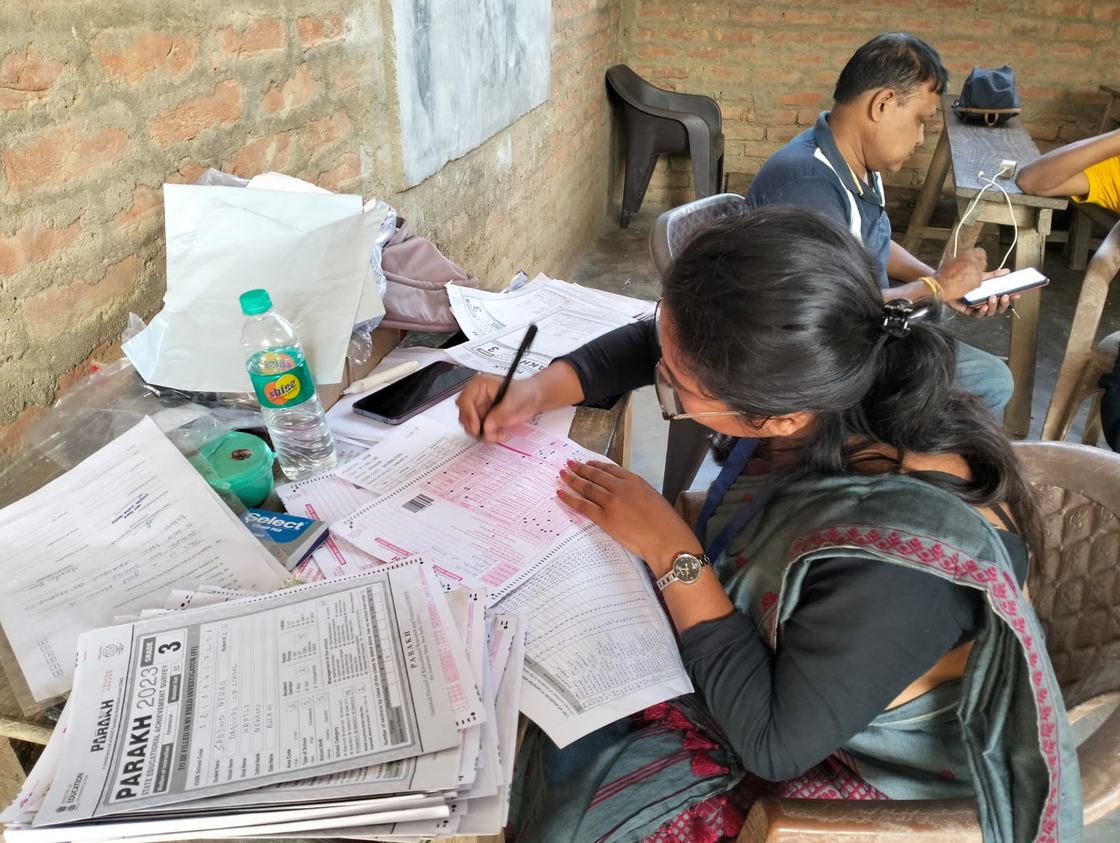
How will the OMRs be filled by grade 3 students?
The OMRs for Grade 3 students will be filled by Field Investigators and Observers maintaining sanctity.
Can students or teachers take the survey material home?
No, the students or teachers cannot take any survey material at home.